Quick Takeaways
- Natural gas generators connect to utility gas lines and don’t require onsite fuel storage.
- Propane generators use fuel stored in a tank on the property.
- Natural gas is often cheaper to operate, depending on local fuel prices.
- Propane provides an independent fuel supply but requires tank refills.
- Both natural gas and propane generators can provide reliable backup power during Houston outages.
- The best fuel source depends on availability, installation costs, and how long you need backup power.
Natural Gas vs. Propane Generator: Key Differences
The biggest difference between natural gas and propane generators is how they receive fuel. Natural gas generators connect to a utility pipeline, while propane generators draw fuel from a storage tank.
Natural gas is often more convenient for homes with existing gas service. Propane offers more control over fuel storage but requires refills.
Both fuel sources can power a whole house standby generator during an outage.
Many residential standby generators are available in models that support either fuel source. However, the generator must be configured for the fuel being used.
Is Natural Gas or Propane Cheaper for a Whole House Generator?
Natural gas is often cheaper to operate than propane, especially for homes already connected to a gas utility. However, the total cost depends on fuel prices, installation requirements, and how often the generator runs.
Homeowners should compare both the upfront installation cost and the long-term cost of operating the generator.
Installation Costs
Natural gas generator installation may cost less when the home already has adequate gas service. However, the existing gas meter or gas line may need upgrades to support the generator.
Propane generator installation requires an onsite storage tank and a fuel line connecting the tank to the generator. The tank may be purchased or leased from a propane supplier.
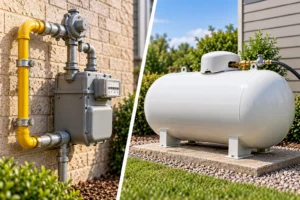 Installation costs depend on several factors:
- Existing gas service: Homes without natural gas service may face additional costs to establish a connection, if one is available.
- Gas meter capacity: A natural gas generator may require a larger meter.
- Propane tank size: Larger tanks cost more but provide additional fuel storage.
- Fuel piping: Both systems require properly sized fuel lines.
- Property layout: Tank placement, generator location, and required clearances affect installation.
A professional installer can evaluate the property and determine which fuel system makes more sense.
Fuel and Operating Costs
Natural gas often costs less to run than propane. Homeowners should compare prices based on the energy each fuel provides.
Natural gas is commonly billed in therms or CCF (hundreds of cubic feet). Propane is usually sold by the gallon.
A generator’s fuel consumption also changes with electrical demand. Running central air conditioning, refrigerators, and other large appliances increases fuel use.
For example, a 22 kW standby generator running at half load will generally consume less fuel than the same generator running at full load.
The actual amount of natural gas a whole house generator uses depends on its size, model, and electrical load.
Homeowners should compare manufacturer fuel consumption ratings with their local natural gas and propane prices before choosing a fuel source.
Which Fuel Source Is More Reliable During a Power Outage?
Both natural gas and propane generators can provide reliable backup power. The main difference is how each fuel source is supplied during an emergency.
Natural gas generators receive fuel through underground utility pipelines. As long as natural gas service remains available, the generator can continue operating without homeowners arranging fuel deliveries.
However, natural gas service can be interrupted during emergencies. Pipeline damage, pressure problems, or utility shutoffs can affect the fuel supply.
Propane generators draw fuel from a tank stored on the property. A full propane tank provides a supply that does not depend on an active natural gas connection.
The drawback is limited fuel storage. Once the tank runs low, homeowners must arrange a delivery.
For Houston homeowners, hurricanes and severe storms make fuel availability an important consideration. Flooding, road closures, and widespread damage can delay propane deliveries. Natural gas service may continue through an electrical outage, but it is not guaranteed.
Neither fuel source is completely immune to storm-related problems.
Is Propane More Efficient Than Natural Gas for Generators?
Propane has more energy per cubic foot than natural gas. But that does not always mean propane generators are more efficient.
Propane has a higher energy density by volume. However, generator efficiency depends on how effectively the engine converts fuel energy into electricity.
The generator’s engine design, fuel system, and electrical load all affect performance.
Some standby generators also have different electrical output ratings depending on whether they run on natural gas or propane.
For example, a dual-fuel-capable generator may produce more rated power on propane than on natural gas. The difference depends on the specific model.
Homeowners should compare manufacturer specifications rather than assume one fuel source always provides better efficiency.
What Are the Pros and Cons of Natural Gas and Propane Generators?
Natural gas generators offer convenient fuel delivery, while propane generators provide onsite fuel storage. Both options have advantages and drawbacks.
Natural Gas Generator Pros and Cons
Natural gas generators are often a practical choice for homeowners who already have utility gas service.
Pros:
- No onsite fuel tank required.
- Continuous fuel supply while utility service remains available.
- Often lower operating costs.
- No need to schedule fuel deliveries.
Cons:
- Requires access to a natural gas utility.
- Gas meter or piping upgrades may be necessary.
- Fuel supply depends on the utility system.
- Natural gas service can be interrupted during emergencies.
Propane Generator Pros and Cons
Propane generators are useful for homes without natural gas service or homeowners who prefer to store their own fuel.
Pros:
- Fuel is stored onsite.
- Does not require a natural gas utility connection.
- Propane can be stored for long periods in a properly maintained tank.
- Tank size can be selected based on expected generator runtime.
Cons:
- Requires space for a propane tank.
- Fuel deliveries must be scheduled.
- Operating costs may be higher.
- Generator runtime is limited by the available propane supply.
Which Generator Fuel Is Best for Houston Homes?
Natural gas is often the better choice for Houston homeowners who already have adequate utility gas service. Propane may be a better option for homes without natural gas access or homeowners who want an onsite fuel supply.
Houston’s hot summers also affect generator selection. Central air conditioning can place a large electrical load on a standby generator during an outage.
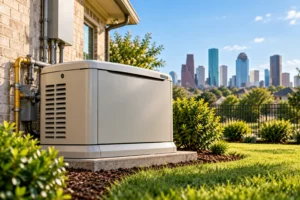 Homeowners should consider:
- Natural gas availability: Does the property already have a suitable gas connection?
- Electrical demand: Will the generator power the entire home or only essential circuits?
- Fuel storage: Is there enough space for a propane tank?
- Outage duration: How long might the generator need to operate without utility power?
- Installation costs: Will the property require gas meter upgrades, new piping, or a propane tank?
Choosing the right size whole house generator is just as important as choosing the fuel source. An undersized generator may struggle to power large appliances, while an oversized unit may cost more than necessary.
For homes in Houston and Pasadena, a professional generator assessment helps find the right system. It considers the home’s power needs and available fuel supply.
FAQs About Natural Gas vs. Propane Generators
Can a Whole House Generator Run on Both Natural Gas and Propane?
Yes. Many residential standby generators are designed to operate on either natural gas or propane. However, the generator must be properly configured for the selected fuel.
Switching between fuels may require manufacturer-approved adjustments or conversion procedures. Homeowners should never attempt to change the fuel configuration without following the manufacturer’s instructions and using a qualified technician.
Does Propane Last Longer Than Natural Gas?
Propane can be stored for long periods in a properly maintained tank without the fuel degrading under normal storage conditions. Natural gas supplied by a utility does not require onsite storage.
For generator runtime, the answer depends on the available fuel supply. A propane generator can operate until its tank runs low. A natural gas generator can continue running as long as utility gas service remains available and the equipment can safely operate.
How Long Will a 500-Gallon Propane Tank Run a Whole House Generator?
A 500-gallon propane tank can power a whole house generator for several days, depending on fuel consumption and electrical load.
Propane tanks are commonly filled to about 80% of their rated capacity to allow for fuel expansion. A full 500-gallon tank therefore holds approximately 400 gallons of propane.
For example, if a generator consumes 3 gallons per hour at a specified load:
400 gallons ÷ 3 gallons per hour = approximately 133 hours
That equals about 5.5 days of continuous operation.
This is an illustrative calculation, not a fuel consumption rating for every generator. Actual runtime depends on the generator model, electrical load, tank fill level, and usable fuel remaining.
Do Natural Gas Generators Work During Hurricanes?
Yes. Natural gas standby generators can provide backup power during hurricanes if the gas supply remains available and the generator is not damaged.
Natural gas pipelines may continue supplying fuel during electrical outages. However, flooding, utility damage, and gas service interruptions can prevent a generator from operating.
Standby generators must also be installed in an approved outdoor location with proper clearances and protection from foreseeable flooding.
Does a Propane Generator Require More Maintenance Than a Natural Gas Generator?
Not necessarily. Propane and natural gas standby generators generally have similar maintenance needs when they use comparable engines.
Both systems require regular oil changes, filter replacements, battery checks, and inspections based on manufacturer recommendations.
Propane systems also require attention to the storage tank, regulator, and fuel lines. Natural gas systems require properly maintained gas piping and connections.
The manufacturer’s maintenance schedule is more important than the fuel type alone.
Find the Right Backup Generator for Your Houston Home
 Choosing between natural gas and propane is an important part of planning a whole house generator installation.
Right Touch Electrical helps homeowners in Houston, Pasadena, and surrounding communities choose the right standby generator for their electrical needs and available fuel source.
Our electricians can help with generator sizing, electrical connections, transfer switches, and installation planning.
Contact Right Touch Electrical to discuss your whole home generator installation and prepare your home for the next power outage.