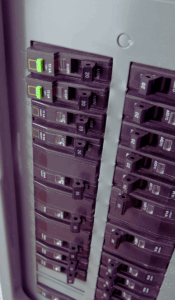
 Where are arc fault circuit breakers required? According to the National Electrical Code (NEC), AFCI breakers—short for arc fault circuit interrupters—are required in the following areas of a home:
- Bedrooms
- Living rooms
- Family rooms
- Dining rooms
- Hallways
- Kitchens
- Laundry areas
- Sunrooms
- Closets
- Other similar living spaces
These apply to 15- and 20-amp branch circuits in new builds and major renovations per NEC 210.12. Local code might vary. Older homes usually don’t require updates unless someone performs major work.
What Is an Arc Fault Circuit Breaker?
An arc fault circuit breaker (AFCI) detects sparking or arcing inside a circuit. Damaged, loose, or degraded wires can cause these faults. Unlike standard breakers, which only trip from overloads or short circuits, an AFCI breaker trips when it detects unsafe arcing.
GFCI protection trips from moisture and shock risk. AFCI protection stops fires from damaged wires. Different threats. Different tools.
NEC Code Requirements for AFCI Breakers
NEC Article 210.12 added AFCI protection for bedrooms in 2002. Over time, it expanded to cover nearly all habitable rooms in dwelling units. The 2014 NEC added kitchens and laundry areas. The 2020 and 2023 NEC continued to support that shift.
Bottom line: 15- and 20-amp 120V branch circuits in most indoor spaces now require a type AFCI breaker or AFCI receptacle.
Full List of Rooms Requiring AFCI Protection
- Bedrooms
- Living rooms
- Dining rooms
- Family rooms
- Hallways
- Closets
- Kitchens (2014 NEC and later)
- Laundry areas (2014 NEC and later)
- Sunrooms
- Similar dwelling spaces
Are AFCI Breakers Required in Garages, Basements, or Outdoors?
 Short answer: not always.
- Garages: Usually exempt from AFCI requirements.
- Basements: Only if they have finished living space like recreation rooms or offices.
- Outdoors: Use GFCI protection instead. AFCIs aren’t required.
Are AFCIs Required in Commercial or Non-Residential Settings?
Nope. Residential homes mainly require AFCI breakers. Some multifamily buildings may have overlapping standards, but commercial properties typically follow different rules.
Local Code Variations and Exceptions
Local building codes can override or delay parts of the National Electrical Code. Always check with your AHJ—that’s short for Authority Having Jurisdiction. If your home was built before these updates and hasn’t been rewired, you may be grandfathered in.
When Do You Need to Upgrade to AFCI Breakers?
You may need to upgrade during:
- Renovations or room additions
- Electrical panel upgrades
- Extending or modifying outlet branch circuits
- Insurance-mandated safety upgrades
Why AFCI Breakers Are Important
Here’s why this matters:
- They prevent electrical fires.
- They detect hidden arc faults behind walls.
- They improve home safety.
- They can increase resale value and reduce liability.
Don’t Skip AFCI Protection
 You might not see sparks inside your walls. That’s why AFCI protection exists. It’s not overkill—it’s code.
Contact Genesis Electrical for AFCI breaker installation, code compliance, and circuit breaker replacements. We serve Houston, TX and nearby areas with quality with a master’s touch.
Our team knows the requirements for AFCI, understands local code, and installs everything from combination type AFCI breakers to full panel upgrades.
Ready to protect your home? Give us a call.